
OPERATING EXPENDITURE BY VOTE
1 below indicates the budgeted expenditure per vote. It can also be observed that the Adjustments budget for 2019/20 increases with R418 million (6.48%)
A logic step for everyone that experience financial problems is to cut back on expenditure. The COVID-19 consequences will have that effect on many businesses and households. This budget doesn’t reflect that and the argument will be that the increases are within inflation limits. But that is missing the point totally.
The budget allocations in the draft budget document are reflected in the Table and Graph below
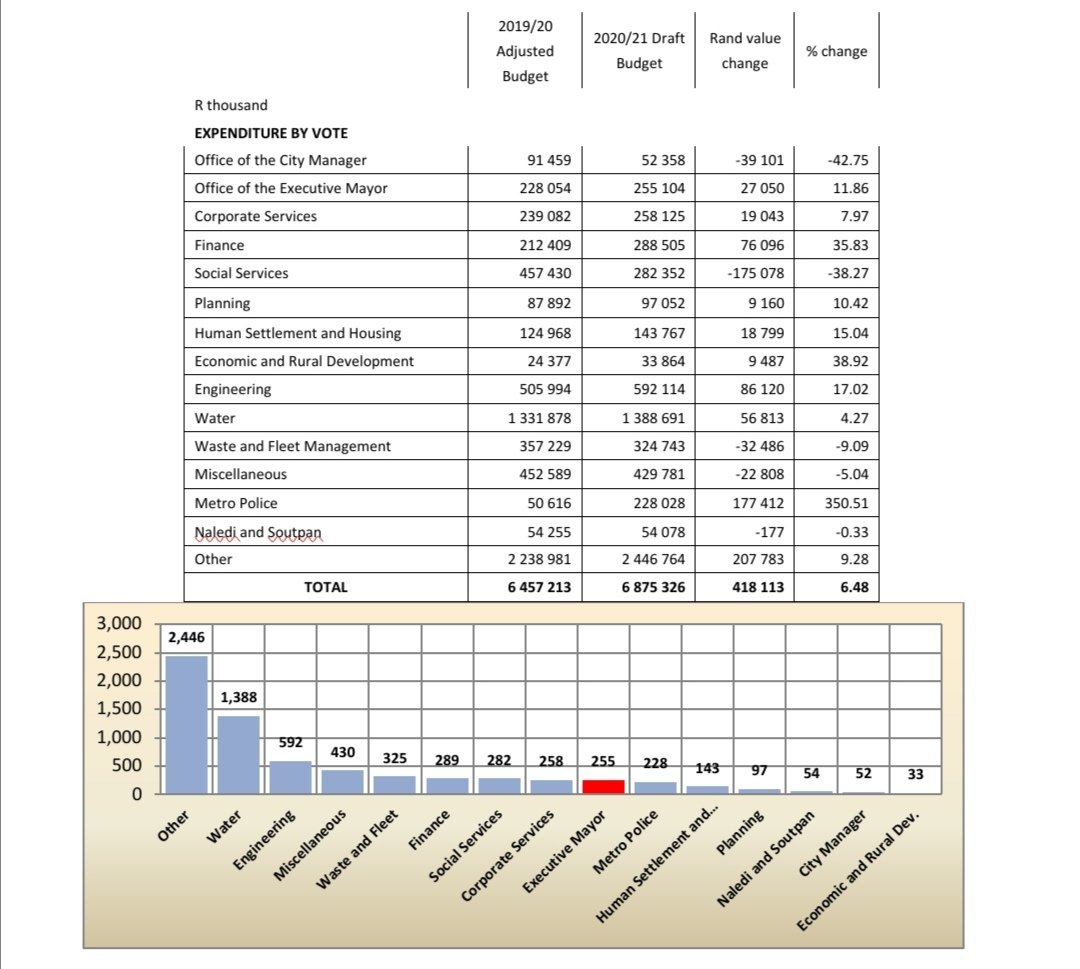
If one wants to fix the finances of the metro you need to understand the spread of budgeted funds amongst Votes. From the above Table and graph it seems as if this is not the best spread to meet the need for service delivery. Detail of the budget under other is not available from the tabled budget that makes it difficult to make a judgement on that. It is good practice when vague descriptions like other are used to also include a table with the detail. For the DA it seems as if there are some empire builders active (HOD’s) in this metro. It is a normal tendency in big organisations where proper management and control is absent.
The Vote of the Executive Mayor is the first one that needs attention. This vote was inflated by creating political jobs for cadre employment and now the ratepayers most foot the bill.
It is also practice, if not controlled by the Municipal Manager and CFO, to build some fat into the budget. It is their responsibility to identify and address this practice.
Some of the items we could identify need attention in our opinion are the following
Project Management………………………….. R71.6 million
Management Fee……………………………….. R38.0 million
Security Services…………………………………. R34.7 million
Air Transport…………………………………….. R 1.4 million
Transport to events…………………………… R 1.3 million
Legal Cost advice and litigation…………. R 14.4 million
Legal Cost collection…………………………. R 36.5 million
Catering……………………………………………. R 1.0 million
These are only a few of the items that can be scrutinised to ensure that the amount provided is the amount needed. The more than R100 million that is budgeted for Project Management and Management Fees raises some question. Why is it needed to this extend whilst the metro employ HOD’s and Senior Managers at a high cost. Are they not capable to perform this function?
The huge increase of R177 million in the budgeted cost of the Metro Police should be put on hold until after COVID-19 and our finances are healthy again.
OPERATING EXPENDITURE BY SOURCE
In the Table below a comparison is made between the Draft Budget and the Financial Performance as at 31 May 2016 to cover the term of the present council up to now.
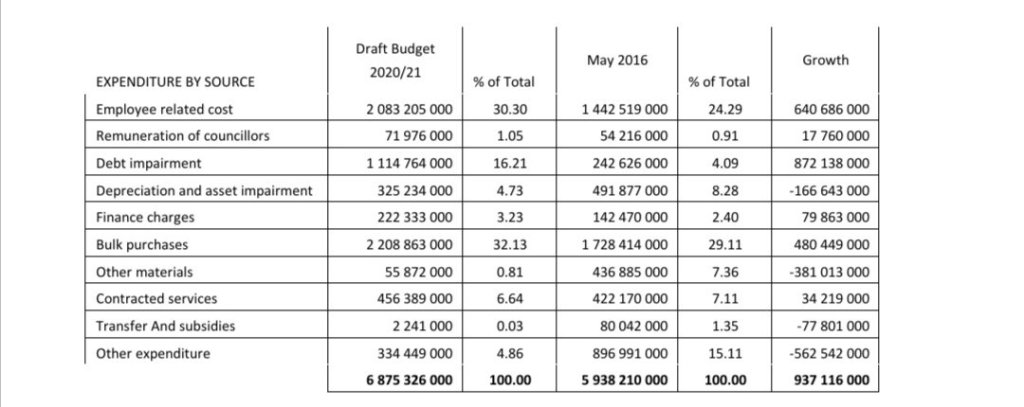
Employee related cost on its own increased with R640 686 000 from R1 442 519 000 to R2 083 205 000. On average this is represent a 9.6% growth per year in the term of the present council
Employee related cost, remuneration of councillors and contracted services amounts to R2 611 570 000 and equals 37.98% of the total budget. Debt impairment amounts to R1 114 764 000 that equals 16.21% of the total budget and Bulk purchases for water and electricity amounts to R2 208 863 000 that equal 32.3% of the total budget.
The total cost of the above three expenditure types amount to R5 935 197 000 that equals 86.3% of the total budget.
One important leg of the process to restore the financial position of the metro is to reduce expenditure where it matters.
The cost of Bulk Service purchases can obviously not be reduced.
The cost of debt impairment can be reduced if the political will and commitment to collect the outstanding debtors will appear for a change.
There is no other option than to address the remuneration expenditure. The logical way is to understand what caused this huge increase in cost and start by rectifying that.
Taking in consideration the fact that there is no provision for overtime in the draft budget one can reach no other conclusion than that this is not a credible budget. The annual cost of overtime up to now varies between R100 to R150 million. Surely that is much too high and must be reduced but to budget zero is ridiculous. For example, water pipes burst also happen at night and weekends and will require overtime to fix that.
If one looks at the R152 million overtime cost for the first ii months of this financial year the following stands out: Executive Mayor R5.4 million, Waste and Fleet Management R53.0 million. This is where one must start in addressing this problem.
Analysis by DA Mangaung Cllr Hans Britz

 Councillor Tjaart van der Walt